
DUGWAY TRAP LINE
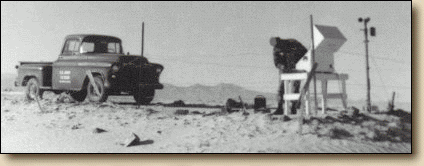
The RATS BBS SysOp gathering data from a trap line station.
Trying to keep tabs on the spread of biologicals released at Dugway the army maintained a series of data gathering stations at the perimeter of the post known as the trap line. The indigenous animal population and local weather patterns meandered across the test grids contaminated with deadly warfare agents at will, taking with them a legacy of disease to the surrounding desert.
Kenneth E. Knowlton, Sig C Met DPG 1959-61.
The Army considers its test bacteria harmless, though no one knows the extent of their effects. Secrecy about the biological defense program has contributed to a spate of nasty rumors. The most recent, involves the outbreak of a mysterious disease in the Southwest that has taken perhaps 30 lives since May. Hanta viruses the apparent cause of the disease, have been studied by military researchers for years, and speculation has arisen that the viruses may have been connected to the outbreak.
Leonard A. Cole, professor of political science at Rutgers in Newark, is author of "Clouds of Secrecy: The Army's Germ Warfare Tests Over Populated Areas."
"The Army found an epidemic of Q fever among Utah desert wildlife in 1959 and 1960, and said it was unsure whether the disease existed there naturally before it was used in Dugway tests". The incidents of Q fever was not reported to the State Health Department but they have recorded cases of Q fever among humans, all after the 1955 releases at Dugway Proving Ground.
Charles Piller, investigative journalist.
With more circumspection but no less diligence, the army tested the real diseases, exploding germ bombs on the test grids at Dugway Proving Ground in Utah. Initially, it tested psittacosis, brucellosis, tularemia, plague, and Q-fever. By 1954, the army added anthrax, San Joaquin Valley Fever (a hardy spore-forming fungus found in California's San Joaquin Valley), and Venezuelan equine encephalitis.
Jeanne McDermott, the 1984-85 Vannevar Bush Fellow in the Public Understanding of Technology and Science at the Massachusetts Institute of Technology, author of "The Killing Winds."
From 1951 through 1969, hundreds perhaps thousands of open-air tests using bacteria and viruses that cause disease in human, animals, and plants were conducted at Dugway. For example, antigens produced by animals that had come in contact with Venezuelan equine encephalomyelitis (VEE), a disease usually found in horses, were later found in animals around Dugway. Prior to the identification of these substances in the Dugway vicinity, VEE had only been identified in the rat population in Florida. Such a finding suggested that VEE had been used in the open-air tests at Dugway or within laboratories, and transferred to the nearby animal population.
IS MILITARY RESEARCH HAZARDOUS TO VETERANS' HEALTH? LESSONS SPANNING HALF A CENTURY U.S. Senate, Committee on Veterans' Affairs, Washington, DC, December 8, 1994.
Testing of deer mice from the Four Corners area indicated that at least one in four had virus with an identical 139- nucleotide sequence as that found in the humans who died. PCR also enabled scientists to look at tissue of deer mice from years back to determine how long the virus had been around and how much or little it had changed. Was the virus new, in which case its power to spread and infect was frighteningly unclear? Genetic material in rodents trapped in the early 1980s and in even older human autopsy tissue suggested it was a fairly old and settled virus with a well- established parasitic relationship with the mice in the area.
The FASEB Journal, Vol. 9, October 1995.
 Return to The RATS Home Page